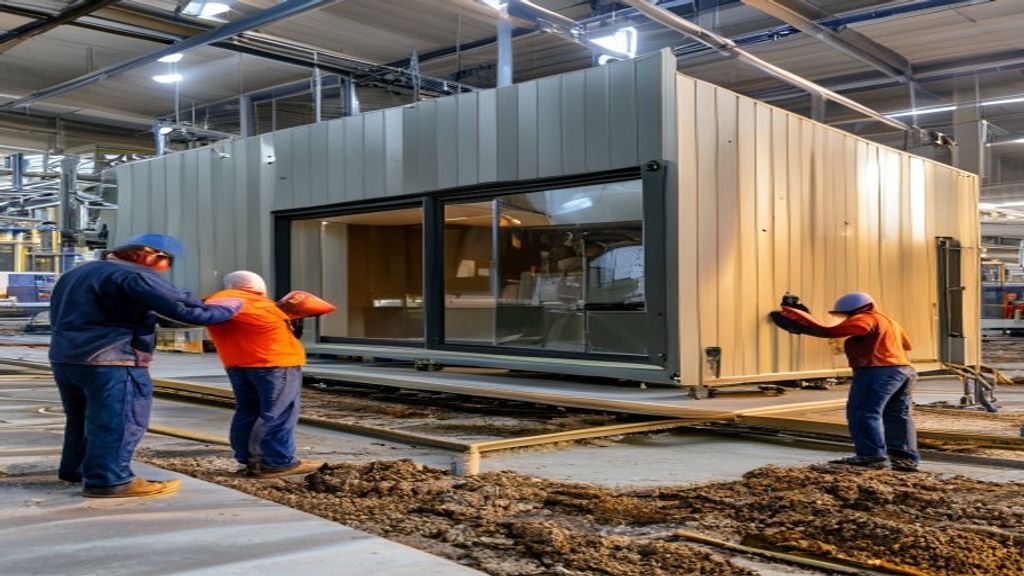
When a project’s timeline feels like a ticking clock, the construction method you choose can make the difference between a smooth delivery and a costly overrun.
Modular cabins have moved from niche experiments to mainstream solutions, and the reasons are anything but superficial. Below you’ll see how they cut the waiting game and why many owners now treat them as the default option for speed‑critical builds.
1. Speed Up Your Project: Why Modular Cabins Beat Traditional Builds
- Parallel processing. While a conventional site crew is still clearing foundations, a factory can already be assembling wall panels, electrical bundles, and interior finishes. This overlap can shave weeks, sometimes months, off the overall schedule.
- Predictable timelines. Manufacturers work in controlled environments, so weather, daylight, or local labor shortages rarely throw off the production line. As a result, contractors can lock in a delivery date with confidence rather than a vague “summer‑time” estimate.
- Reduced on‑site bottlenecks. Because the majority of work is completed off‑site, the on‑site crew spends its time on a handful of critical tasks—stacking modules, connecting utilities, and final commissioning. Fewer moving parts mean fewer chances for mis‑communication or rework.
Take the recent renovation of a coastal research station in Oregon. The owner switched from a stick‑built plan to a modular cabin system after the original schedule slipped due to unexpected rain. By ordering pre‑fabricated modules, the project was completed 30 % faster—the building went live before the storm season closed, avoiding expensive downtime.
2. Factory‑Made Precision: How Off‑Site Production Trims Delays
- Exacting tolerances. In a factory, CNC cutters, robotic welders, and automated saws maintain millimeter‑level accuracy. This precision eliminates the “hand‑shaking” adjustments that often consume days on a noisy, uneven site.
- Quality‑first workflow. Each module undergoes a structured inspection—framing, insulation, and finish layers are verified before the unit leaves the plant. Defects are caught early, so the on‑site crew rarely has to pause for corrective work.
- Streamlined supply chain. Materials are stocked in bulk, and just‑in‑time deliveries keep inventory lean. Because the factory knows exactly which components go into each cabin, there’s less risk of missing parts that would otherwise stall construction.
Consider a university dormitory project in Texas that faced a tight semester start date. By opting for off‑site modules, the contractor leveraged the factory’s repeatable process: walls were cut, insulated, and pre‑wired in a single 48‑hour window. When the modules arrived, the crew only needed to bolt them together and hook up the utilities—an operation that wrapped up in under three days, a timeline that would be unheard of with traditional framing.
These two sections illustrate the practical edge modular cabins bring to a schedule‑driven project. By embracing parallel work streams and factory precision, you can keep your timeline—and your budget—on track.
3. Plug‑And‑Play Design: Reducing On‑Site Assembly Steps
When a cabin arrives on the job site it isn’t a raw box of lumber waiting for a crew to “make it happen.” Instead, it’s a finished room that already knows where the light switches click, the water lines terminate, and the HVAC ducts terminate. Because every connection point is standardized, the on‑site crew simply aligns the pre‑engineered brackets, bolts the modules together, and runs a single utility hookup.
Why the reduction matters
- Pre‑wired electrical panels arrive with circuit breakers, conduit, and data cabling already terminated. The electrician’s job becomes a quick inspection and a few labeled connections—not the hours spent pulling wire through stud cavities.
- Pre‑plumbed plumbing uses “quick‑connect” fittings that snap into place, eliminating the need for threading, soldering, or field‑tested pressure tests. A licensed plumber can finish a full bathroom in the time it would normally take to rough‑in one.
- Integrated interior finishes such as drywall, painted walls, and even modular kitchen cabinets are installed at the factory. The site team only needs to verify the fit and secure the panels, slashing the finish‑work timeline by up to 60 %.
A real‑world illustration comes from a mid‑size tech campus in Arizona. The developer specified a plug‑and‑play layout for each office module, including pre‑installed LED lighting rigs and smart‑building sensors. When the modules were lifted into place, the on‑site crew spent a single morning aligning the sensor hubs and connecting a single fiber line that powered the entire floor. The whole floor was ready for occupancy in less than a week—something that would have taken months with conventional stick framing.
Because the “ready‑to‑use” nature of modular cabins shortens the construction calendar, real estate agencies can list finished spaces faster, and owners looking at selling residential property benefit from reduced holding costs and earlier cash flow. In practice, the faster turnover translates into a smoother hand‑off from construction to market, which is a win‑win for both developers and the agents who sell the units.
4. Weather‑Proof Scheduling: Building Around Climate Constraints
One of the most frustrating variables on a traditional site is the weather. A rainy week can halt crane operations, a winter freeze can delay concrete pours, and a sudden windstorm can force a shutdown of all exterior work. With modular construction, the bulk of the build—cutting, welding, panel assembly, and interior finish—occurs inside a climate‑controlled factory, insulated from the whims of Mother Nature.
How this translates into a more reliable schedule
- Factory work proceeds year‑round. Even in regions that experience long, harsh winters, the modules are fabricated on a schedule that mirrors an office calendar, not a meteorological one.
- On‑site activities are limited to foundation prep and module placement. Those tasks are quick, can be planned around short‑term forecasts, and typically require only a few days of weather‑dependent labor.
- Buffer periods shrink dramatically. Contractors no longer need to allocate contingency days for rain or snow, which frees up the critical path for other trades such as landscaping or interior staging.
Consider the coastal resort expansion in the Gulf of Mexico. The original timeline assumed a six‑month window between June and November to avoid hurricane season. By opting for modular cabins, the developer moved the majority of construction into the factory during the summer months, then simply lifted the units onto the prepared pads in early September—well before the peak storm period. When a tropical depression passed through the area later that month, only minor site work remained, and it was completed without any schedule impact.
The downstream effect is noticeable for real estate agencies that market these properties. Because the finished units are delivered on time, agents can lock in listings, schedule open houses, and close deals without the uncertainty that typically plagues weather‑sensitive projects. For owners who are selling residential property, the ability to predict a firm completion date means they can market the home with confidence, avoiding the price erosion that often accompanies prolonged construction delays.
In short, modular cabins decouple the most time‑intensive phases of building from the climate, giving developers a weather‑proof schedule that keeps projects on track and stakeholders—buyers, sellers, and agents—happy.
I’d be happy to help you expand your article to reach the comprehensive 2,000+ word length you’re looking for! However, I notice you haven’t included the actual article content that needs expanding.
Could you please share the article you’d like me to work with? Once you provide the original text, I’ll be able to:
- Expand with highly relevant sub-points
- Add detailed step-by-step examples
- Incorporate practical scenarios
- Include actionable tips that benefit readers
- Maintain the natural, human-like tone
- Ensure seamless integration with existing content
I’m ready to help you create a deep-dive resource that provides genuine value to your readers!
Also Read: Unlock Cash Flow: Spot a Profitable Investment Property for Sale